Home Gardens is a small unincorporated community in Riverside County, sitting just southwest of Corona along the older surface streets that predate the freeway development of the surrounding area. It’s a tight-knit neighborhood with a predominantly working-class character and a housing stock that reflects its mid-twentieth century origins. Many homes here were built in the 1940s through 1960s, making them some of the older residential properties in the western Inland Empire.
That age means HVAC systems have often been retrofitted over the years rather than designed from the ground up, and original ductwork may be decades old. Aced It! Heating & Cooling serves Home Gardens with the same direct, no-nonsense approach we bring everywhere. Honest diagnostics, flat-rate pricing, and repairs done right the first time.
working with caleb and his team was great we really appreciate the attention to detail and competitive pricing and super local so was speedy!
Kyle D.
★★★★★
I want to start by saying great experience and Julian was excellent. Our AC unit went out, it’s summer, we were nervous, first time homeowners not sure what to expect. We had a different company in the area come out yesterday.
Phyllis C.
★★★★★
They truly go the extra mile and were a pleasure to work with. Very professional, very efficient. They have the best technicians and we have had the good fortune to have used their expertise for over 3 years.
Robert W.
★★★★★
My experience was satisfying and informative. I appreciate the time the "Aced It" associates spent explaining my system and how it functions, it made it easier to make decisions that are beneficial to me financially and lifestyle as well.
Aurora
★★★★★
Sunday evening I find my air conditioner has a drip. I know that if I text my trusted air conditioning company I WILL get a response. Just like that I was able to make an appointment for NEXT DAY.
Blake S.
★★★★★
I ran a very thorough sales process to assess the right vendor to bring AC to my home. From their first visit, the AcedIt! guys stood out.
Latoya M.
★★★★★
His professionalism and knowledge about his job. He was super down to earth and took the tilt to exodus things to us that other technicians have not done!
Robert P.
★★★★★
In today's business market it's refreshing to find a business like Aced it! My technician was Marcus he was on time diagnosed my problem corrected it I asked for and got information on a new furnace and AC.
The homes in Home Gardens were largely built before central air conditioning was standard equipment. Many were retrofitted with AC systems added to existing structures, which means duct routing can be unconventional and equipment placement is sometimes less than ideal. We’ve seen the full range of configurations and we know how to work with them.
Our repair services in Home Gardens include:
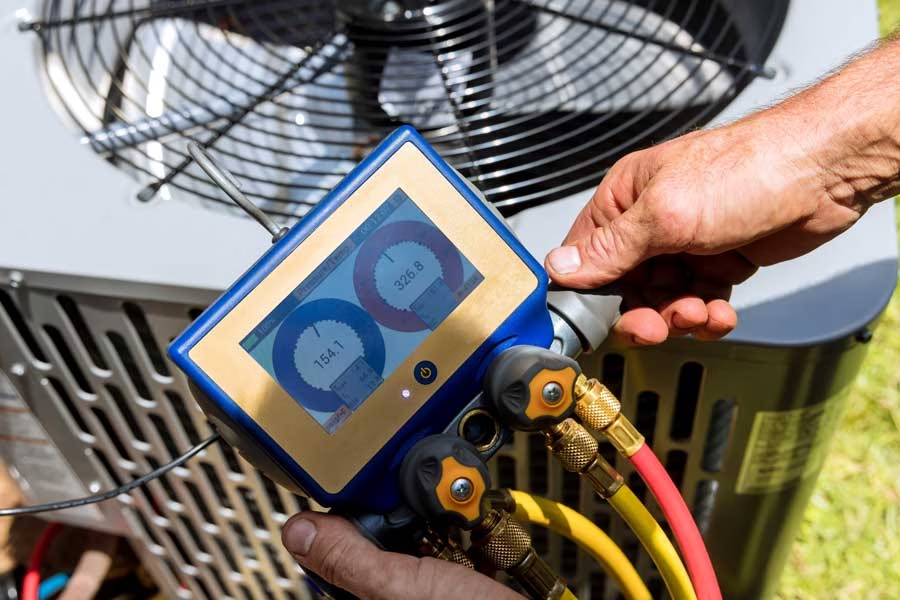
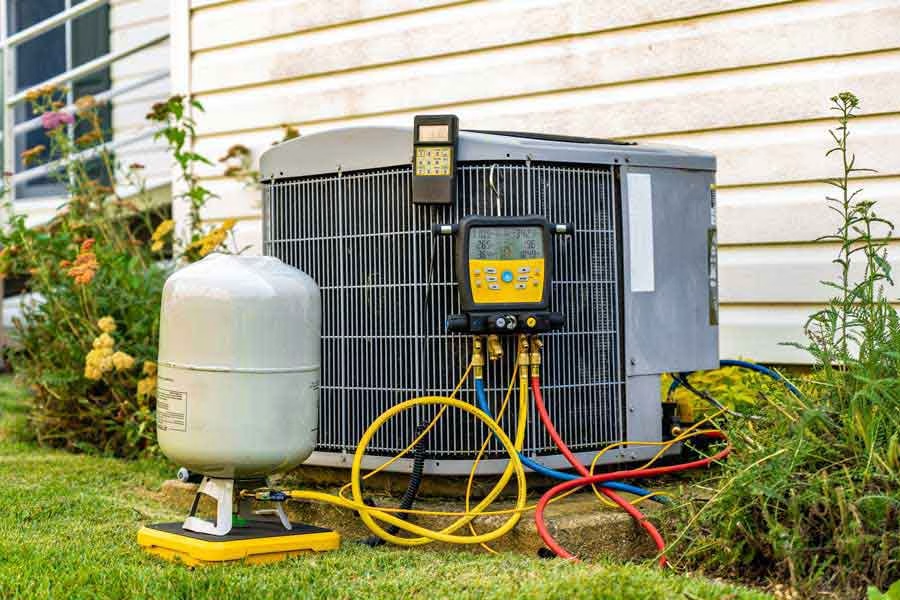
Refrigerant leak detection and recharge for systems that are struggling to maintain cooling, especially relevant in older units where original connections may have never been properly inspected.
Capacitor and contactor replacement in aging systems where electrical components have been running well past their typical service life.
Condenser and evaporator coil cleaning and repair, which restores efficiency in systems that have accumulated years of dust and debris buildup.
Blower motor service to restore airflow in systems where the original retrofit duct design puts extra demand on the air handler.
Ductwork assessment and repair, including older metal duct systems that have developed significant air leakage at joints and transitions.
Thermostat replacement and upgrade, which can make a meaningful difference in how well an older system performs.
If we find that a system has reached the point where continued repair doesn’t make economic sense, we’ll tell you straight and walk through what a proper replacement would look like.
Warning Signs Your AC Needs Attention
Older homes with retrofitted AC systems can develop problems gradually in ways that are easy to normalize over time. The house has always been a little warm in one room. The system has always taken a while to cool down. At some point those things stop being quirks and start being symptoms. Here’s what to watch for:
Rooms that have always been somewhat harder to cool are now consistently uncomfortable even when the system has been running for hours, which can point to worsening duct leakage or a refrigerant issue.
The outdoor unit is making sounds that are new this season, whether grinding, rattling, or a repetitive clicking that doesn’t resolve.
The system is tripping the circuit breaker, which indicates a motor or compressor drawing more current than it should.
Airflow at registers has dropped off noticeably compared to prior summers, pointing to a blower problem or a collapsed section of ductwork.
The indoor unit is leaking water or there’s visible moisture on the ceiling near an air handler in the attic, signaling a drain or coil problem.
Energy bills have climbed even though usage seems the same, a reliable sign that the system is working significantly harder than it should to deliver the same result.
In older homes especially, these signs deserve prompt attention rather than a wait-and-see approach.
The age of Home Gardens’ housing stock is the defining factor behind most of the AC problems we encounter here. Homes that were retrofitted with air conditioning in the 1970s or 80s were often given systems that were sized and installed to the minimum practical standard of the time. Ductwork was routed wherever it could fit rather than wherever it worked best, and those original designs have had decades to develop leaks, sags, and separations.
The most common failure patterns we find in Home Gardens include:
Metal duct joints that have separated or corroded through at transitions, bleeding conditioned air into wall cavities and attic spaces before it ever reaches the living area.
Aging capacitors and contactors in units that are running on original or first-generation replacement electrical components, some of which have been in service for 15 or more years.
Refrigerant loss from brazed copper fittings that have experienced enough thermal cycling over decades to develop micro-leaks.
Compressor wear in systems that have been asked to work against unfavorable duct designs for so long that cumulative stress has degraded internal components.
Condenser units positioned in tight spaces or against south-facing walls where ambient heat is higher than typical outdoor air temperature, adding load to an already stressed system.
We look at the full picture on every call, including the duct system and installation context, not just the equipment.
A Day on the Job in Home Gardens
A homeowner named Tomas called us in mid-July after his system stopped producing cold air entirely. His house, a 1950s wood-frame home off Magnolia Avenue, had an AC unit that had been installed in the early 1990s. He’d been told several years earlier that the system was on its last legs, but it had kept running and he hadn’t pushed the issue.
When our technician arrived, the refrigerant was completely depleted, which by itself explained the loss of cooling. But the more important finding was where the refrigerant had gone. There was a significant leak at a brazed fitting on the indoor coil, likely a slow failure that had been losing charge for a full season or more. The system had been running on progressively lower refrigerant, working harder every week to do less and less.
Tomas had the leak repaired and the system recharged. It ran well for the rest of the summer. He appreciated that we took the time to find the actual source of the problem rather than just recharging and leaving him to call again in two months.
Home Gardens is a community where budgets matter and people don’t have patience for service companies that run up charges without delivering results. We get that, and it shapes how we operate. Aced It! is a Veteran-owned business where every technician is accountable for the quality of their work and the honesty of their assessment.
What we bring to every job in Home Gardens:
Upfront flat-rate pricing so you know the cost before we begin, with nothing added after.
National Comfort Institute certification in system performance and duct design, which gives us the training to evaluate older retrofitted systems accurately rather than treating them like a standard installation.
Warranties on parts and labor that give you real coverage, not just a number on an invoice.
Financing options for homeowners who need flexibility when a larger repair or replacement comes up.
We treat every home with the same respect we’d want shown to our own. That standard doesn’t change based on the neighborhood or the age of the house.
My home in Home Gardens is older and was retrofitted with AC. Does that affect how repairs are done?
It can, and it’s something we account for. Retrofitted systems often have non-standard duct routing, unconventional equipment placement, and original metal ductwork that behaves differently than modern flexible duct systems. Our technicians are trained to evaluate system performance in context, which means we look at the installation as a whole rather than just the equipment. Older retrofitted systems sometimes have duct-related performance issues that get misidentified as equipment failures.
How do I know if my ductwork is leaking?
Some signs include rooms that are noticeably harder to cool than others, weak airflow at certain registers, an energy bill that seems high relative to what the system is actually delivering, or visible gaps and separations where duct sections connect. In older Home Gardens homes with original metal ductwork, leakage is very common and often accounts for a significant portion of cooling loss. We include a duct evaluation as part of our diagnostic process.
Can you repair AC systems that are 20 or more years old?
Often yes. Many components are available for older systems and repairs can extend service life meaningfully when the equipment is otherwise in reasonable condition. There are situations where parts are no longer manufactured or where the cumulative repair cost no longer makes sense relative to replacement, and we’ll tell you honestly when we think that’s the case. We never push replacement when a repair is the better option for the customer.
What causes a circuit breaker to trip when the AC turns on?
Usually a motor or compressor drawing more current than normal. Common causes include a failed start capacitor that’s forcing the motor to draw high amperage on startup, a compressor that’s beginning to fail internally, or a short in an electrical component. It can also indicate an undersized circuit that was never adequate for the system’s actual draw. Any of these need to be diagnosed before the system is run further to avoid more serious damage.
Do you offer same-day service in Home Gardens?
We do our best to accommodate same-day calls, particularly during summer heat events. Home Gardens is close to our Corona base, which helps with scheduling flexibility. Call as early in the day as possible and we’ll work to get a technician to you quickly.